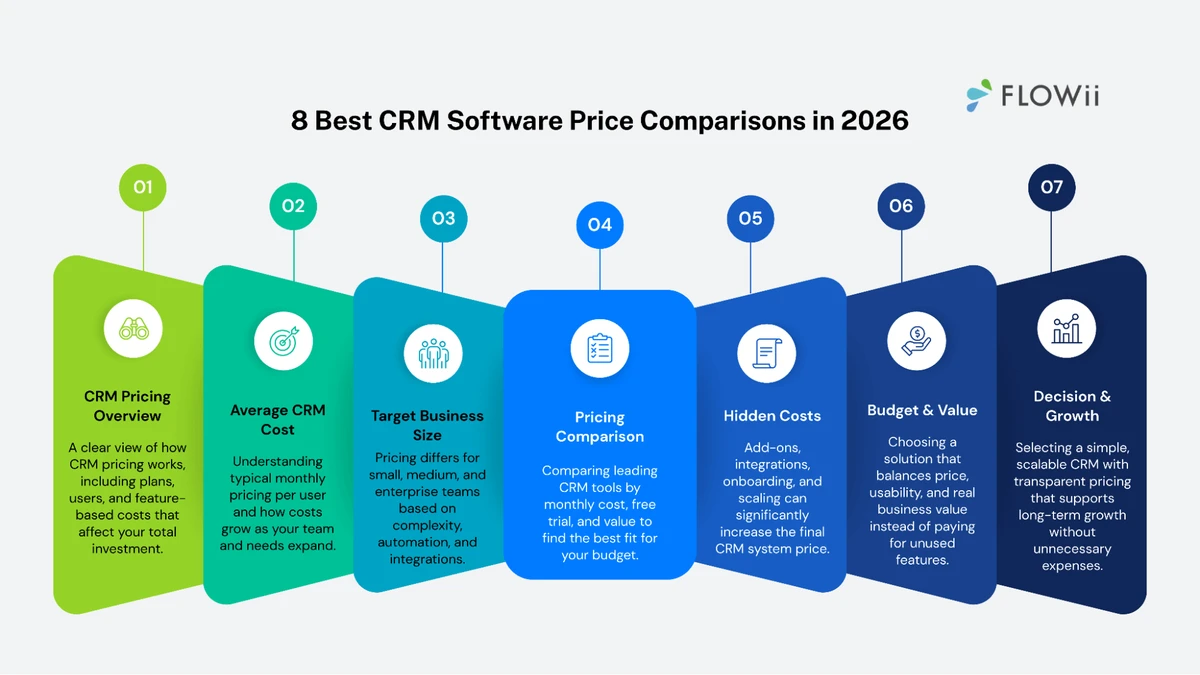
For 2026, the best CRM value depends on your growth stage: Saleoid is the most affordable for micro-teams ($5/mo), Zoho and Bigin offer the best entry-level scaling, while HubSpot and Salesforce remain the high-cost, high-power enterprise standards. However, the ‘sticker price’ is often misleading due to mandatory onboarding and AI usage credits. Hidden CRM costs—including integrations, API limits, and mandatory onboarding—often double the real bill within the first year.
Quick Verdict: Which CRM fits your 2026 budget?
Choose Saleoid or Bigin for ultra-low budgets. Opt for Zoho CRM or Monday CRM for mid-market scaling. Select HubSpot or Salesforce for enterprise-grade automation and ecosystem integration, though costs for advanced tiers can be significant.
Budget allocation for 2026 should prioritize the “real” cost of the team size expected in 12 months rather than current headcount. For those requiring high-end automation, certain Salesforce tiers are available, while those seeking a balance of power and price can find Zoho CRM Standard at $14/user/month.
CRM Vendor |
Entry Price (Annual) |
Scaling Model |
Key ‘Hidden’ Cost |
|---|---|---|---|
Saleoid |
$5/month |
Low-cost flat/seat |
Integration limits |
Bigin |
$7/user/month |
Per-seat |
Tier upgrades |
Zoho CRM |
$14/user/month |
Tiered per-seat |
Advanced module add-ons |
HubSpot |
$45/seat/month |
Per-seat + Min User |
Mandatory onboarding |
Salesforce |
$25/user/month |
Tiered per-seat |
Implementation services |
This table illustrates the wide gap between entry-level tools and enterprise platforms. While Saleoid offers the lowest barrier to entry, the scaling model of HubSpot—which requires a 5-user minimum for Professional tiers—creates a significant jump in the total cost of ownership.
The 2026 Pricing Landscape: Per-Seat vs. Flat-Rate
The primary financial tension in CRM procurement for 2026 is the choice between per-seat licensing and flat-rate models. Per-seat pricing creates a linear cost increase that penalizes organizational growth, while flat-rate models provide predictable budgeting regardless of user count.
The Per-Seat Growth Penalty
Per-seat models create a “growth penalty” where every new hire increases the monthly software bill. For example, scaling a team on a per-user plan can lead to unpredictable budget spikes. This model often discourages broad organizational adoption because managers may limit seat access to save costs, thereby reducing the CRM’s effectiveness as a single source of truth.
Flat-Rate: Encouraging Organizational Adoption
Flat-rate pricing, such as PipeBase’s $99/month for up to 40,000 records, removes the friction of adding new users. This encourages all stakeholders to use the system without worrying about the marginal cost of an additional seat. The break-even point typically occurs when a team exceeds 5-10 users; at this stage, a flat-rate fee often becomes cheaper than the cumulative cost of individual licenses in mid-tier per-seat plans.
- Per-seat: Costs scale linearly with headcount.
- Flat-rate: Costs remain static regardless of user growth.
- Hybrid: Some vendors charge a base fee plus a smaller per-user fee.
Uncovering the ‘Hidden’ Costs of Implementation
Real CRM costs include mandatory onboarding fees (required for HubSpot Professional/Enterprise), implementation services ($1,200–$5,000), and API overages. Many vendors offer annual discounts of 15-25%, but these require upfront payment and may not be available on a month-to-month basis.
Subscription fees are only one part of the total expenditure. Professional services for setup and data migration are critical but often omitted from headline pricing. For instance, HubSpot Professional can cost $1,600 and Enterprise $5,000 for specific user brackets, but these figures often exclude the mandatory onboarding fees required to activate those tiers.
Annual billing typically provides savings of 15-25%, but this requires a large upfront capital outlay. Organizations with tight monthly cash flow should verify if the monthly rate is significantly higher, as some vendors use the annual price as a marketing lure while charging a premium for flexibility.
AI Credit Economics: The New 2026 Variable
The introduction of AI-driven features has shifted CRM pricing from static subscriptions to hybrid models involving usage credits. This adds a layer of unpredictability to monthly billing, as AI tokens are consumed based on the volume of requests rather than the number of users.
Vendors are increasingly adopting “credit-based” economics for AI capabilities. This means that even if a company pays for a high-tier seat, they may face additional costs if their AI automation exceeds a monthly credit limit. For example, Salesforce’s Agentforce 1 Sales is priced at $550/user/mo, reflecting the high cost of the underlying compute power required for autonomous agents.
- Bundled AI: A set number of credits included in the monthly seat price.
- Pay-as-you-go: Additional charges based on token or request volume.
- Tiered AI: Access to more powerful models unlocked only at the Enterprise level.
Comparing Free Tiers and Their ‘Hard Ceilings’
Free CRM tiers are designed as acquisition funnels with “hard ceilings” that force a transition to paid plans once a business reaches a specific scale of data or automation.
The most common ceiling is the contact limit. HubSpot offers a generous free tier with a limit of 1,000,000 contacts, whereas HelloGrowthCRM limits its free plan to 150 leads. These limits determine how long a company can operate without a paid subscription before their database becomes locked or unusable.
- Contact Ceilings: HubSpot (1M contacts) vs. HelloGrowthCRM (150 leads).
- Feature Locks: Advanced automation and sequence tools typically require a jump to paid tiers.
- User Limits: Many free plans limit the number of administrative users, requiring a paid “Admin” seat to manage the system.
FAQ
How much does a typical CRM implementation cost in 2026?
Estimated implementation fees can be significant, often doubling the first-year bill when combined with mandatory onboarding for high tiers.
Is annual billing always cheaper than monthly?
Generally yes, with typical savings of 15-25%, but users should check if the annual rate is available month-to-month to avoid budget surprises.
What is the most affordable CRM for a small team in 2026?
Saleoid is cited as the most affordable at $5/month, followed by Bigin at $7/user/month.
To finalize your 2026 budget, you should now calculate your Total Cost of Ownership (TCO) by projecting your team size for the next three years and adding estimated onboarding fees to the subscription totals. Compare the break-even point where a flat-rate model becomes more cost-effective than per-seat pricing based on your specific growth trajectory.