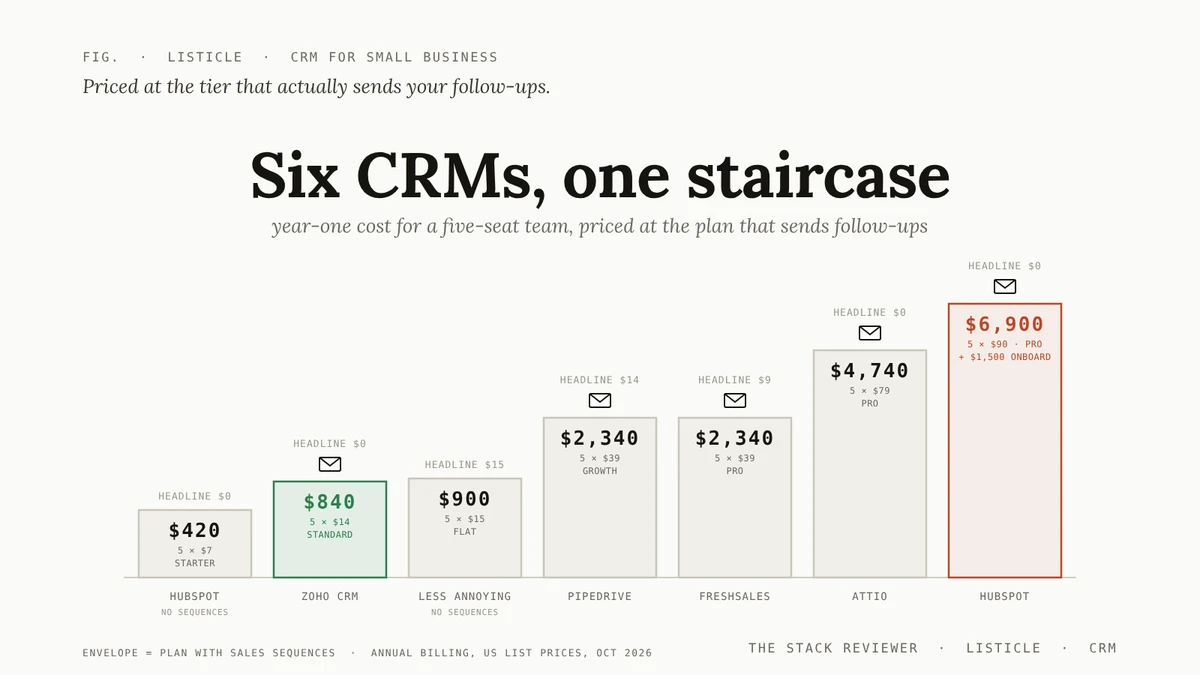
For US small businesses, the best CRM depends on team structure: Zoho CRM is the top overall choice for affordable automation and low scaling costs, Bigin is best for solopreneurs needing 30-minute deployment under $21 per month, and Salesforce Starter leads for turnkey agentic AI. While HubSpot offers an attractive free tier, its multi-year scaling costs reach $12,000 per year for 10 users compared to alternatives like Zoho Pro at $2,760 per year, making HubSpot 4.3 times more expensive.
What Really Matters When US Small Businesses Choose a CRM
The best CRM for a US small business depends on team size and operational complexity: Bigin is ideal for micro-businesses seeking budget setup under 30 minutes, Zoho CRM offers the strongest balance of automation and multi-year value, and Salesforce Starter delivers turn-key agentic AI for growing sales teams.
Data from the Small Business Administration (SBA) establishes that 30 million small businesses represent 99% of all US enterprises and generate 54% of total sales across the nation. In this massive commercial footprint, operational efficiency directly dictates survival. Research from SuperOffice indicates that 91% of companies with more than 11 employees use a CRM to organize client records, automate pipeline milestones, and coordinate outreach. Despite this high adoption rate, many small firms struggle because leadership selects platforms based on exhaustive marketing feature lists rather than actual day-to-day sales habits.
For American operators, software selection must account for strict regulatory frameworks alongside core sales workflows. Built-in dialers and messaging modules must handle Application-to-Person 10-Digit Long Code (A2P 10DLC) carrier registration to prevent cellular carriers from filtering customer SMS notifications. Platforms must also support compliance with the CAN-SPAM Act through verifiable physical address footers, align with federal one-to-one consent mandates for digital lead capture, and provide automated audio disclosure prompts to satisfy two-party call recording consent statutes in states such as California and Florida.
Bigin by Zoho for Micro-Teams Needing Rapid Setup
Forbes Advisor awarded Bigin a 4.6-star rating, naming it the premier CRM for teams operating on a strict budget. Engineered specifically for micro-businesses, freelancers, and small trade shops, Bigin strips away the enterprise bloat that frequently paralyzes first-time software users. The platform operates on pipeline-focused cards, allowing owners to visualize deal movements without configuring hundreds of backend database fields.
Pricing remains exceptionally accessible, spanning from a functional free tier up to $21 per user per month for its top-tier plan. This structure enables lean operations to secure pipeline visibility, basic telephony, and automated activity tasks without committing to four-figure annual software contracts. Solo operators can configure custom deal stages, connect incoming business emails, and launch operations in under 30 minutes. By eliminating technical onboarding hurdles, Bigin ensures that business owners spend their working hours closing business rather than managing software settings.
Zoho CRM for Scalable Sales Automation at Low TCO
Zoho CRM serves expanding sales organizations requiring deep workflow automation without escalating software expenditures. Standard tier pricing begins at $14 per user per month, providing an accessible baseline for small businesses moving beyond simple spreadsheets into multi-stage pipelines. Quantitative market research proves the economic return of structured CRM systems: Nucleus Research reports an average return of $8.71 for every dollar invested, Cloudswave documents conversion rate improvements of up to 300%, and Capterra records a 47% increase in customer retention.
“With Zoho CRM, we experienced a 65% increase in our sales pipeline. We also managed to reduce our lead to real prospect time by 60%, which is huge.”
— Zoho CRM Customer Testimonial
Field sales teams benefit from the platform’s mobile architecture. The mobile application includes automated GPS deal geotagging during customer on-site visits, allowing outside sales reps to log interactions and verify client meetings directly from location coordinates. Built-in offline synchronization ensures that reps working in rural areas, basements, or commercial job sites without cellular signals can update deal records, record voice notes, and review account histories. The local mobile cache syncs with the central database the moment the device reconnects to a network.
Salesforce Starter for Turn-Key Agentic AI Pipelines
Salesforce Starter provides small businesses with an out-of-the-box system that unifies sales, service, and marketing into a single subscription. Smaller enterprises have historically avoided enterprise ecosystems due to the requirement of hiring specialized consultants or full-time database administrators. Salesforce designed Starter to remove this administrative barrier, packaging essential contact pipelines and customer support tools into pre-built operational flows.
“Most small business CRMs do one thing really well and leave you stitching together the rest. Salesforce is the turn-key agentic CRM – not just a contact database, but a platform pre-built by experts that connects sales, service, marketing, and AI in one connected experience from day one.”
— Salesforce
The system incorporates Salesforce Agentforce autonomous AI technology, deploying autonomous AI agents capable of handling repetitive front-line communication tasks. These agents qualify incoming inbound website inquiries, update lead pipeline statuses based on buyer intent, and route complex technical customer cases directly to available team members without human dispatching. By consolidating marketing campaigns, pipeline tracking, and customer service desks under one roof, Salesforce Starter prevents small companies from managing fragmented point solutions and disjointed billing cycles across multiple SaaS providers.
HubSpot CRM for Inbound Teams Willing to Pay for Scale
HubSpot CRM remains a prominent choice for inbound marketing teams due to its clean interface and generous entry-level tools. The permanent free tier includes contact management, basic form generation, landing page creation, and email interaction tracking. This free offering allows early-stage companies to capture leads and monitor prospect interactions across corporate websites without upfront capital expenditure.
“The best free CRM software for small businesses in 2026 and 2027 isn’t the platform with the longest feature list — it’s the one that matches how a specific team actually sells.”
— ConvergeHub Editorial
Despite the utility of its entry tier, companies must evaluate HubSpot’s steep multi-year cost escalation. A 10-user deployment on HubSpot Professional costs $12,000 annually, representing a 4.3x multiplier over equivalent mid-tier platforms like Zoho Pro, which costs $2,760 per year for the same user count. This transition creates a severe scaling barrier for growing operations. When a business outgrows the free tier’s constraints—such as seat caps, restricted automation branches, and basic reporting—the sudden cost jump can disrupt operating margins.
Top Niche Contenders for High Contact Databases and Field Sales
Specialized business models require specific architectural strengths rather than general-purpose contact managers. The following platforms address unique operational requirements, including high-volume contact directories, complex lead nurturing sequences, and zero-cost live customer support.
Salesmate for Unlimited Contact Records
Salesmate stands out for businesses managing extensive customer lists, wholesale directories, or high-volume outbound prospecting campaigns. Forbes Advisor notes that Salesmate distinguishes itself by allowing organizations to store unlimited contacts without penalizing growth through contact-tier paywalls. Traditional CRM systems frequently charge secondary storage penalties when databases cross arbitrary contact thresholds. Salesmate eliminates this friction, making it an effective choice for B2B distributors, commercial agencies, and real estate operations handling broad lead volumes.
Keap for Automated Intake and Multi-Channel Capture
Keap focuses on automated lead capture and structured sales automation for service-based small businesses. The software provides built-in business card scanning tools, point-of-sale (POS) intake connections, and dynamic saved-search segmentation filters. These tools allow service contractors, medical practices, and professional consultants to turn physical customer interactions into structured follow-up sequences. Prospects can test these automated capture tools, text messaging triggers, and email sequences via a 14-day free trial that requires no credit card on registration.
Agile CRM and Freshsales for Generous Entry Tiers
Agile CRM delivers a functional free tier, making it suitable for boot-strapped commercial teams. Its free tier incorporates email tracking, automated email campaigns, branded outbound emails, unlimited deal tracking stages, and contact record storage. This combination provides micro-teams with integrated marketing outreach capabilities rarely found in entry-level packages.
Freshsales addresses operational reliability by offering a free plan that includes weekday customer support via phone, live chat, and email. While competing software providers restrict direct human assistance to premium enterprise plans, Freshsales provides direct technical troubleshooting to non-paying users. Other budget options in the market include Bitrix24, which offers paid plans starting at $49 for five users with annual prepayment, and Vtiger, which supports an entry tier with a 3,000-contact ceiling.
The Real Cost of Scaling: 3-Year TCO and Platform Breakdown
The primary financial risk in software procurement is failing to anticipate the three-year Total Cost of Ownership (TCO). While entry tiers often appear budget-friendly, secondary cost drivers quickly inflate operational expenses. These drivers include third-party middleware fees to connect external accounting platforms, usage-based telephony add-on credits, and mandatory paid onboarding fees required by platforms before unlocking essential custom reporting or granular permission controls.
A direct comparison reveals dramatic budget variances between standard platforms. Zoho Pro charges $2,760 annually for a 10-user team, whereas HubSpot Pro requires $12,000 per year for the same team size, making HubSpot 4.3 times more expensive. The table below outlines real-world operational pricing, core advantages, and architectural trade-offs across the top options for US small businesses.
CRM Platform |
Target Team & Best For |
Pricing & 10-User TCO |
Operational Advantage |
Growth Trade-off |
|---|---|---|---|---|
Bigin |
Solopreneurs & micro-teams |
Free to $21/user/mo |
30-minute deployment; simple visual deal cards |
Limited complex automation and enterprise branching |
Zoho CRM |
Growing small businesses |
Starts at $14/user/mo; Pro is $2,760/yr for 10 users |
Lower licensing cost vs HubSpot; GPS mobile check-ins |
Broad feature depth requires disciplined setup rules |
Salesforce Starter |
Lean sales & support teams wanting AI |
Turn-key agentic CRM suite |
Pre-built Agentforce AI; sales, service & marketing in one |
Less granular customization than full Salesforce tiers |
HubSpot CRM |
Inbound marketing-focused sales teams |
Free basic tier; Pro is $12,000/yr for 10 users |
Intuitive user interface; fast employee onboarding |
4.3x cost multiplier over Zoho; contact tier markups |
Salesmate |
High-volume prospecting & outbound sales |
Contact management platform |
Allows unlimited contact records without price hikes |
Smaller third-party native app marketplace |
Keap |
Appointment & service businesses |
Paid automation plans; 14-day free trial |
Built-in POS intake, business card scans & SMS sequences |
Higher entry baseline price for solo operators |
CRM Platform |
Target Team & Best For |
Pricing & 10-User TCO |
Operational Advantage |
Growth Trade-off |
|---|---|---|---|---|
Bigin |
Solopreneurs & micro-teams (1-5 users) |
Free to $21/user/mo ($2,520/yr for 10 users on top plan) |
30-minute deployment; simple visual deal cards |
Limited complex automation and enterprise branching |
Zoho CRM |
Growing small businesses (5-50 users) |
Starts at $14/user/mo; Pro is $2,760/yr for 10 users |
73% licensing savings vs HubSpot; GPS mobile check-ins |
Broad feature depth requires disciplined setup rules |
Salesforce Starter |
Lean sales & support teams wanting AI |
$25/user/mo entry ($3,000/yr for 10 users) |
Pre-built Agentforce AI; sales, service & marketing in one |
Less granular customization than full Salesforce tiers |
HubSpot CRM |
Inbound marketing-focused sales teams |
Free basic tier; Pro is $12,000/yr for 10 users |
Intuitive user interface; fast employee onboarding |
4.3x cost multiplier over Zoho; contact tier markups |
Salesmate |
High-volume prospecting & outbound sales |
Starts around standard entry tiers |
Allows unlimited contact records without price hikes |
Smaller third-party native app marketplace |
Keap |
Appointment & service businesses |
Paid automation plans; 14-day free trial |
Built-in POS intake, business card scans & SMS sequences |
Higher entry baseline price for solo operators |
When selecting software, accounting integration must be evaluated alongside seat prices. CRMs that offer native, bi-directional synchronization with accounting tools allow sales quotes to convert directly into receivable invoices upon closing a deal. In contrast, platforms lacking native connections require continuous paid subscriptions to middleware services, introducing data sync errors and increasing weekly administrative overhead.
Why 70% of CRM Deployments Fail and How to Beat the Odds
Approximately 70% of CRM implementations fail because companies treat deployment as a software installation rather than a process change. Successful US small businesses overcome this by conducting a 90-day adoption audit tracking unprompted user logins, proactive data entry outside review cycles, and the complete retirement of offline tracking spreadsheets.
Analyst estimates compiled by ZDNet show that approximately 70% of CRM implementations fail to achieve their primary business goals. Industry professionals emphasize that technical bugs rarely cause these abandonments. Organizational habits and implementation planning represent the true points of vulnerability.
“The biggest risk isn’t picking the wrong software; it’s poor setup and low adoption. Plan implementation and training as seriously as selection.”
— Ross Peetoom, VP Professional Services, Faye
“In Vantage Point’s delivery experience, most CRM failures relate to people-related challenges, while only a small share stem from actual technical problems with the software itself.”
— Vantage Point
Warning: Common Implementation Traps That Corrupt CRM Health
System failure typically traces back to three operational errors: migrating uncleaned legacy data, permitting non-standardized field entries, and selecting overly complex software tiers. Importing years of fragmented, unverified spreadsheets introduces duplicate records that erode sales rep confidence on day one. Similarly, allowing team members to create unstandardized custom fields leads to empty data sets, while purchasing enterprise systems bloated with unused features frustrates employees and drives them back to personal note apps.
To avoid these pitfalls, small businesses must execute a systematic audit during the first quarter of deployment. Tracking team habits through five practical checkpoints ensures the system takes root across daily operations:
- Checkpoint 1: Unprompted Daily Logins — Sales reps and service technicians open the CRM interface independently at the beginning of each business day without prompting from managers.
- Checkpoint 2: Real-Time Pipeline Adjustments — Stage changes, lead qualifications, and client touchpoints occur within hours of actual client meetings rather than during rushed data-entry sessions right before weekly sales reviews.
- Checkpoint 3: Complete Spreadsheet Retirement — Personal desktop spreadsheets, paper notebooks, and rogue tracking sheets are decommissioned. Leadership establishes that any deal missing from the CRM database does not exist for commission calculations.
- Checkpoint 4: Contextual Note Depth — Activity logs record concrete conversational details, customer objections, and specific agreed next actions rather than empty placeholder records like “called client” or “left voicemail.”
- Checkpoint 5: Cross-Platform Data Sync Health — Inbound lead capture forms, calendar links, and QuickBooks accounting connections fire correctly without orphaned contacts, broken field mappings, or API disconnect alerts.
Executing these operational reviews keeps team members aligned, preserves database integrity, and ensures the chosen software delivers measurable revenue growth over the long term.
FAQ
What US compliance regulations must a small business CRM support?
A US small business CRM must support A2P 10DLC carrier registration for SMS messaging, comply with CAN-SPAM commercial email guidelines, enforce FCC one-to-one consent mandates, and provide automated audio notifications for two-party call recording consent laws in states like California and Florida.
How can a small business prevent CRM data pollution during migration?
Businesses must clean legacy databases before uploading, implement strict layout field rules, configure mandatory deduplication parameters, and validate contact formatting to avoid importing fragmented records that ruin reporting and team adoption.
Does a small business need dedicated IT staff to run these platforms?
No. Modern platforms like Bigin, Salesforce Starter, and Zoho CRM are architected for non-technical owners to configure in hours. However, companies must establish clear data-entry standards and continuous usage audits to ensure sales reps consistently update pipelines.