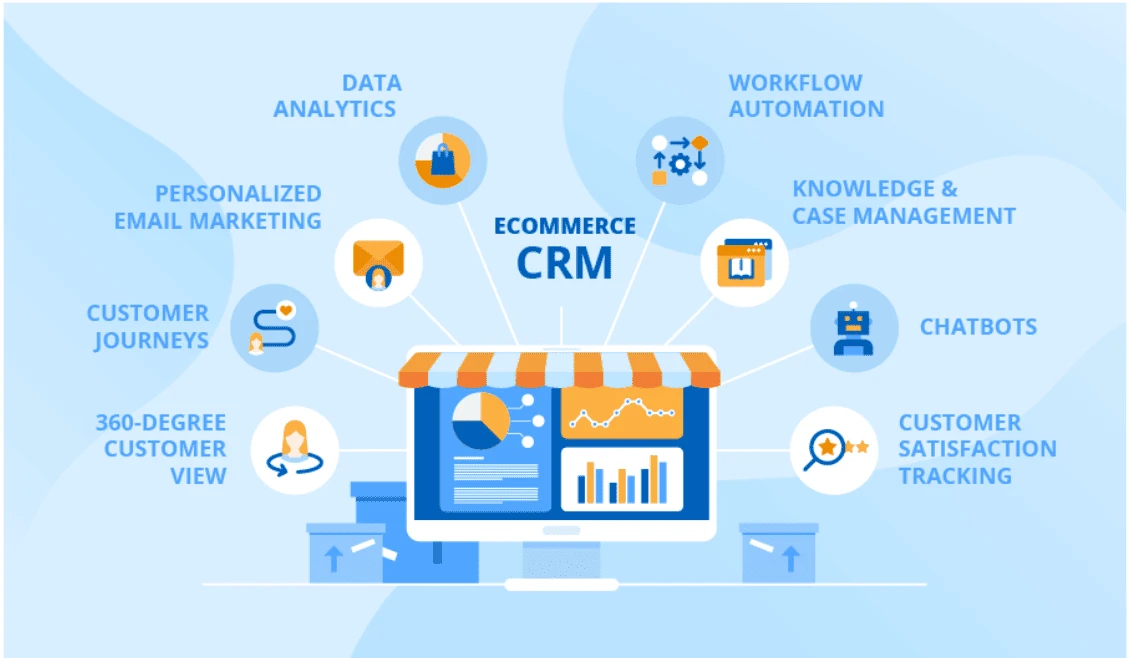
An ecommerce CRM is a centralized ‘single source of truth’ that unifies customer data, behavioral habits, and transaction history to enable 1:1 personalization at scale. Unlike traditional CRMs, it is optimized for high transaction volumes and rapid, trigger-based buyer journeys rather than long-term B2B sales pipelines. Industry experts assert that for e-commerce businesses, a CRM is no longer optional to avoid the ‘guesswork’ of online business management.
Why standard B2B CRMs fail in ecommerce
Traditional B2B CRMs are designed for long sales cycles and manual lead nurturing. Ecommerce CRMs differ by optimizing for high transaction volumes, anonymous-to-known buyer journeys, and real-time behavioral triggers that must fire in minutes to capture impulsive or repeat purchases.
Conventional B2B CRMs struggle with B2C speed and scale, often resulting in fragmented channels and data silos. Because they prioritize lead scoring and deal stages, they lack the agility required for the rapid-fire nature of online shopping. This creates a gap where personalization is limited and integrations with ecommerce tools are weak, according to Klaviyo.
Criterion |
Ecommerce CRM |
Traditional B2B CRM |
|---|---|---|
Focus |
Online sales and customer experiences |
Uniting employees and customers via sales profiles |
Optimization Goal |
Repeat purchases and abandoned carts |
Lead scoring, nurturing, and deal stages |
Buyer Journey |
High-volume, rapid behavioral triggers |
Long-term sales pipelines and manual nurturing |
The primary difference lies in the objective: while a B2B system tracks a prospect through a multi-month negotiation, an ecommerce CRM tracks a user from an anonymous click to a repeat purchase in seconds. This shift in focus allows businesses to optimize for post-purchase engagement rather than just the initial closing of a deal.
The operational impact of a unified customer view
A unified customer view eliminates the fragmented data that leads to operational inefficiency. BigCommerce states that an ecommerce CRM acts as a single source of truth, housing customer data, behaviors, and habits in one location.
When data is centralized, the business can move beyond guesswork to make evidence-based decisions. This operational clarity manifests in several specific areas:
- Financial Efficiency: CRM systems reduce the time and resources required for interactions, which allows ecommerce companies to spend less on attracting new leads and retaining customers over time, according to industry analysts.
- Inventory Precision: Integration with ecommerce platforms allows for real-time inventory updates across all sales channels, increasing overall accuracy, as noted by software providers.
- Targeted Marketing: Businesses can use inventory turnover data to launch specific marketing efforts that focus on slower-moving products, as highlighted by BigCommerce.
- Personalization: Unifying data enables 1:1 personalization at scale, allowing brands to respond faster to customer needs and save employee time through automation, according to Klaviyo.
How to build your ecommerce customer profiles
Building an ecommerce customer profile involves collecting data from digital touchpoints—including website visits, order history, and live chat—and organizing them into profiles. This data then feeds automation rules for welcome emails, cart abandonment alerts, and personalized offers based on real-time triggers.
The process follows a logical flow from raw data collection to active revenue generation:
- Data Collection: Gather information from various digital touchpoints, including product views, website visits, payment methods, order history, and live chat interactions.
- Profile Organization: Organize this raw data into detailed profiles that include personal details, customer preferences, and a history of support tickets.
- Automation Configuration: Set up rules based on specific triggers—such as new signups, repeat purchases, or periods of inactivity—to fire welcome emails, cart abandonment alerts, or personalized offers.
By implementing this flow, businesses can move from generic broadcasting to behavioral targeting. For example, a trigger based on a repeat purchase can automatically move a customer into a “Loyalty” segment, triggering a different set of rewards than a first-time buyer would receive.
Choosing the right CRM for your business scale
Deciding when to move from basic marketing automation to a dedicated CRM depends on specific operational tipping points. You have likely outgrown simple email lists if you experience fragmented data across new channels (like wholesale or pop-ups), struggle to track the anonymous-to-known buyer journey, or find that your current tools cannot handle real-time behavioral triggers and RFM scoring without extensive manual work.
The choice of CRM then depends on the balance between the need for unique, custom workflows and the speed of implementation. Industry-specific tools generally lead to faster and more effective implementation because they are prebuilt for the ecommerce sector.
Lightweight options for startups
Startups often require tools that are easy to deploy and cost-effective. Vtiger CRM is positioned as a lightweight option for startups, while Pipedrive offers a sales-focused solution for small ecommerce businesses. Capsule CRM is another user-friendly alternative for small to medium-sized operations.
Scalable solutions for mid-market
As businesses grow, they require more robust automation and integration capabilities. Zoho CRM provides a customizable system with automation and support features, starting at 14 USD per user per month for the standard plan. HubSpot offers an all-in-one approach with both free software and premium plans for larger brands, and Insightly provides scalable project management for mid-to-large businesses.
Enterprise-grade custom builds
For organizations with highly specific requirements or massive user bases, custom builds are often the only viable path. Dynamics 365 CRM is recommended for high-priced B2C or B2B ecommerce segments. The cost for these systems varies significantly based on scale.
CRM Type |
Target Scale |
Estimated Cost |
Implementation Speed |
|---|---|---|---|
Platform-based |
Startups to Mid-Market |
Low (e.g., 14 USD/user/mo) |
Fast |
Entry-Level Custom |
10+ Users |
15,000 USD |
Moderate |
Large-Scale Custom |
1,000+ Users |
250,000 USD |
Slow |
Platform-based tools are generally faster and cheaper with less maintenance, whereas custom systems are reserved for those with established, unique workflows that off-the-shelf software cannot support.
Avoiding common integration pitfalls
Integration failure rarely stems from the software itself, but rather from the operational environment surrounding the tool. Without a clear strategy, a CRM can become a costly database that no one uses correctly.
A critical risk occurs when businesses expand their sales channels. Adding new channels, such as wholesale or retail pop-ups, without a unified CRM causes a break in customer continuity. In these cases, each new channel starts from scratch, and the business loses the ability to track purchase history across the entire customer journey.
Operational functionality also fails when a business selects a CRM that lacks native ecommerce platform connectors. If the system cannot provide RFM (Recency, Frequency, Monetary) or CLV (Customer Lifetime Value) scoring and real-time behavioral segmentation out of the box, the business will be forced into expensive and time-consuming custom development.
FAQ
What is the difference between a CRM and an ERP for ecommerce?
An ERP focuses on back-office functions such as HR, finance, and inventory management. In contrast, a CRM is designed to house customer data specifically to drive sales and marketing efforts.
How much does an ecommerce CRM typically cost?
Costs vary by scale: Zoho CRM’s standard plan starts around 14 USD per user per month. For custom systems, an entry-level build for 10+ users starts at 15,000 USD, while large-scale systems for 1,000+ users can reach 250,000 USD.
Can a CRM help with inventory management?
Yes. Integrated CRMs can increase accuracy by updating inventory in real-time across all sales channels. Businesses can also use inventory turnover data to trigger marketing campaigns for slower-moving products.